-
![]() Picture: Bild: MMollaretti - stock.adobe.com
Picture: Bild: MMollaretti - stock.adobe.com![]() Picture: Bild: MMollaretti - stock.adobe.com
Picture: Bild: MMollaretti - stock.adobe.comX-replacement with benefits
2025/02/04
TU researchers present the first comprehensive study on the Bluesky platform
The booming short messaging service Bluesky is not only a suitable alternative to X, but also offers users real advantages: This is the conclusion reached by a research team with leading participation from TU Darmstadt in a study on the platform with the blue butterfly logo.
-
![]() Picture: Patrick Bal
Picture: Patrick Bal![]() Picture: Patrick Bal
Picture: Patrick BalNew at etit
2025/01/14
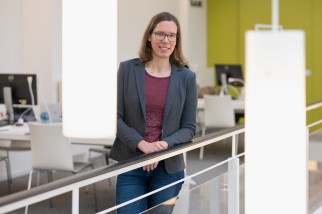
Professor Anna C. Bakenecker
The Technische Universität Darmstadt welcomes Dr Anna C. Bakenecker as a new professor in the Department of Electrical Engineering and Information Technology (FB 18). The 35-year-old physicist and expert in the field of medical technology conducts research with a particular focus on magnetic micro- and nanorobotics.
-
![]() Picture: Jordan Strauss/Invision for the Television Academy/AP Content Services
Picture: Jordan Strauss/Invision for the Television Academy/AP Content Services![]() Picture: Jordan Strauss/Invision for the Television Academy/AP Content Services
Picture: Jordan Strauss/Invision for the Television Academy/AP Content ServicesAI for the big stage
2024/12/20
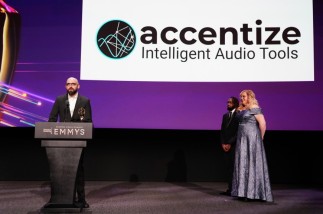
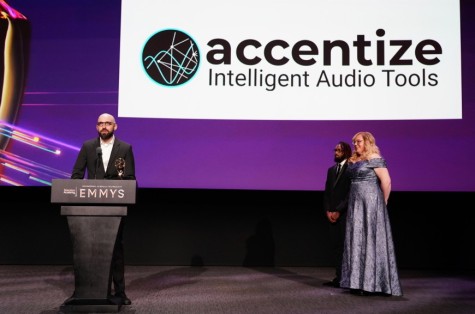
TU alumnus wins Emmy Award for audio technology
Benjamin Graf studied Electrical Engineering and Information Technology at TU Darmstadt, then worked for two years in a hearing aid technology company, set up his own business and finally founded the start-up ‘Accentize’. When you listen to the 34-year-old talk about how his path took shape, this year's Emmy Award in Los Angeles seems only logical.
-
![]() Picture: Bild: Gerd Keim
Picture: Bild: Gerd Keim![]() Picture: Bild: Gerd Keim
Picture: Bild: Gerd KeimState of Hesse continues to fund emergenCITY until the end of 2026
2024/12/12
LOEWE committees approved further funding totalling around nine million euros
Once again, the LOEWE centre emergenCITY has been able to convince the LOEWE committees and the Hessian Ministry of Science with a comprehensive concept paper. On 4 December, they decided to release a further nine million euros in state funding from the LOEWE programme, which promotes excellent research in Hesse, for the years 2025 and 2026.
-
![]() Picture: Fachgebiet HBA
Picture: Fachgebiet HBA![]() Picture: Fachgebiet HBA
Picture: Fachgebiet HBAExperimental Lectures
2024/12/06
Eleonorenschule as a guest at etit
On 05 December 2024, the Eleonorenschule visited the high-voltage hall in Griesheim for an experimental lecture. The pupils were shown various fun experiments from the fields of high-voltage and high-current technology.
-
![]() Picture: Marcel Geibel
Picture: Marcel Geibel![]() Picture: Marcel Geibel
Picture: Marcel GeibelHessian University Award for Excellence in Teaching 2024
2024/12/03
Interdisciplinary TU course “Shaping the energy transition” receives award
An interdisciplinary team from the departments of Social Sciences and History and Electrical Engineering and Information Technology (etit) at TU Darmstadt has been awarded the prestigious Hessian University Prize for Excellence in Teaching, endowed with 60,000 euros, for the course “Shaping the Energy Transition”. The award-winning course offers students of political science and engineering the opportunity to understand and tackle the complex challenges of the energy transition.
-
![]() Picture: Tessa Scheufler
Picture: Tessa Scheufler![]() Picture: Tessa Scheufler
Picture: Tessa ScheuflerEnrichment for the university landscape
2024/11/08
Awards presented to international students
This year's German Academic Exchange Service (DAAD) prize for outstanding achievements by international students at TU Darmstadt goes to Anna Klyushina, at the time of nomination a student on the Master's degree course in Mechatronics with a specialization in Robotics. The award, endowed with 1,000 euros, was presented at a ceremony at which the winners of international scholarships at TU Darmstadt were also honored.
-
![]() Picture: Betsy Scrip
Picture: Betsy Scrip![]() Picture: Betsy Scrip
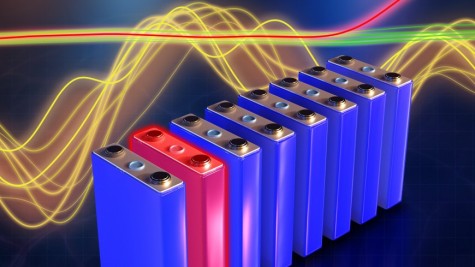
Picture: Betsy ScripEarly detection makes batteries safer
2024/10/30
TU Darmstadt and MIT develop methods for monitoring with machine learning
The safe use of lithium-ion batteries, such as those used in electric vehicles and stationary energy storage systems, critically depends on condition monitoring and early fault detection. Failures in individual battery cells can lead to serious issues, including fires. To mitigate these risks, researchers at TU Darmstadt and the Massachusetts Institute of Technology (MIT) have developed novel methods for battery analysis and monitoring that leverage physically constrained machine learning approaches.
-
![]()
![]()
Communicating biomaterials
2024/10/30
Professor Heinz Koeppl, Darmstadt spokesman of the project ‘CoM2Life’, in a video interview
The cluster initiative ‘COM2Life’ is a project within the framework of the Rhine-Main Universities (RMU), with TU Darmstadt and Johannes Gutenberg University Mainz as partners. Professor Koeppl introduces the research project, which aims to develop a new generation of soft biomaterials.
-
![]() Picture: Fraunhofer IMTE
Picture: Fraunhofer IMTE![]() Picture: Fraunhofer IMTE
Picture: Fraunhofer IMTEMicrorobots for drug transport
2024/10/29
LOEWE Start Professorship: Anna C. Bakenecker receives two million euros
Dr Anna C. Bakenecker has been awarded a LOEWE Start Professorship at TU Darmstadt. The expert in medical physics is working on the development, control and monitoring of nano- and microrobots that are designed to transport drugs to their target sites in the body. The LOEWE research funding programme of the state of Hesse is providing around two million euros over a period of six years.
-
![]() Picture: Heike Jüngst
Picture: Heike Jüngst![]() Picture: Heike Jüngst
Picture: Heike JüngstAI instead of chemistry
2024/10/28
Start-up ViSPAGI turns cancer diagnostics on its head
Cancer is one of the most frightening diagnoses for many people. According to statistics from the Robert Koch Institute (RKI), around half of the German population will develop the disease in the course of their lives. There are around 500,000 new cases in Germany every year. But there is hope: more than half of those affected survive, thanks in part to improved diagnostics. Young etit scientists are revolutionising cancer diagnosis with their start-up ViSPAGI.
-
![]()
![]()
New podcast gleichstellung@etit
2024/10/24
Episode 5 from High-Tech Women 2024
It is generally recognised that diversity and equality are not only beneficial, but also essential for our modern, western world. How does a traditionally male-dominated subject like electrical engineering deal with this? How can we get more women interested in this forward-looking field? In the fifth episode of the podcast gleichstellung@etit, Sarah reports on her visit to High-Tech Women 2024, a conference organised by the CySec division of the Department of Computer Science at TU Darmstadt.
-
![]() Picture: KOM
Picture: KOM![]() Picture: KOM
Picture: KOMTireless commitment to human and technical networking
2024/10/14
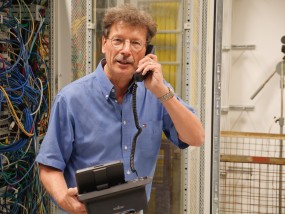
Interview with Prof Dr Dr h.c. Ralf Steinmetz before his retirement
After 28 years at the Technical University of Darmstadt, Professor Ralf Steinmetz is retiring. Until the end of the special research centre ‘MAKI – Multi-Mechanism Adaptation for the Future Internet’, he has agreed to take on all tasks as its spokesperson. In this interview, the head of the Multimedia Communication Lab looks back on this time. He talks about challenges and his grand vision, provides insights into how the collaboration between different researchers and different technical communication systems has been successful – and reveals how research and teaching can continue to be successfully organised in the future.
-
![]() Picture: Klaus Mai
Picture: Klaus Mai![]() Picture: Klaus Mai
Picture: Klaus MaiMembers of the state parliament Schmitz and Franz visit the TU
2024/09/30
etit scientists present their research
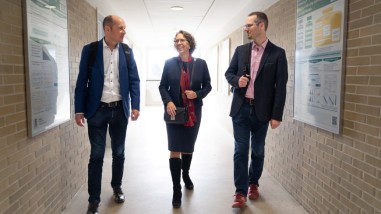
In September, Lucas Schmitz and Peter Franz from the Hessian State Parliament visited TU Darmstadt. The visit focussed on TU Darmstadt's diverse contributions to shaping the future. Two etit scientists were invited to present their research work.
-
![]() Picture: privat
Picture: privat![]() Picture: privat
Picture: privatHigh honours
2024/09/26
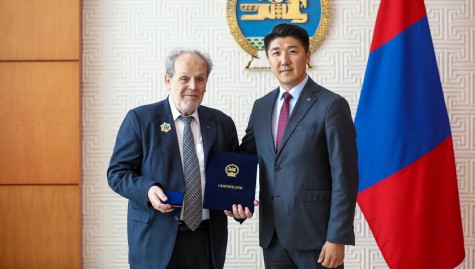
Emeritus etit Professor Glesner receives the Order of the Polar Star
Emeritus etit professor Manfred Glesner has been awarded a high-ranking honour in Mongolia. He received the so-called Order of the Polar Star from the East Asian country in the capital Ulan Bator. Glesner was honoured for his services to educational cooperation between Germany and Mongolia over more than 35 years.

Department of Electrical Engineering and Information Technology
News from the Department etit
Archive












Contact
Kommunikation etit

kommunikation@etit.tu-...
work +49 6151 16-20208
Work
S3|21 104
Fraunhoferstraße 4
64283
Darmstadt